Expanding Mental Health Access for Men Through Awareness, Research, and Conversation
Mental health conversations do not begin equally for everyone.
For many men, emotional distress is often carried silently, shaped by cultural expectations around strength, independence, and emotional control. In many communities, particularly within Hispanic and multicultural populations, conversations around anxiety, depression, emotional exhaustion, or psychological vulnerability may be delayed for years, even when support is needed.
These barriers can directly impact how individuals engage with healthcare systems, seek professional guidance, or consider participating in mental health research.
In clinical research, this reality matters.
Limited engagement from male participants affects more than representation alone. It can influence how mental health conditions are understood across populations, how treatment responses are evaluated, and how future care strategies are developed for the communities research is intended to serve.
At Indago Research, mental health research is approached with the understanding that access begins long before enrollment. It begins with communication, trust, cultural awareness, and the ability to create environments where participants feel respected and understood throughout the research process.
For many individuals, entering a mental health study may begin with uncertainty. Questions are often shaped not only by the condition itself, but also by stigma, family dynamics, cultural expectations, or previous experiences with healthcare environments. Addressing those barriers requires more than operational structure alone. It requires human understanding integrated into the clinical experience itself.
This is why participant communication, transparency, and respectful engagement remain central to how Indago Research approaches mental health research.
Creating meaningful access also strengthens research quality. Broader participation supports more representative data, deeper population insight, and a more complete understanding of how mental health conditions affect diverse communities in real-world settings. For sponsors and research partners, this contributes to research environments better aligned with the realities of modern patient populations.
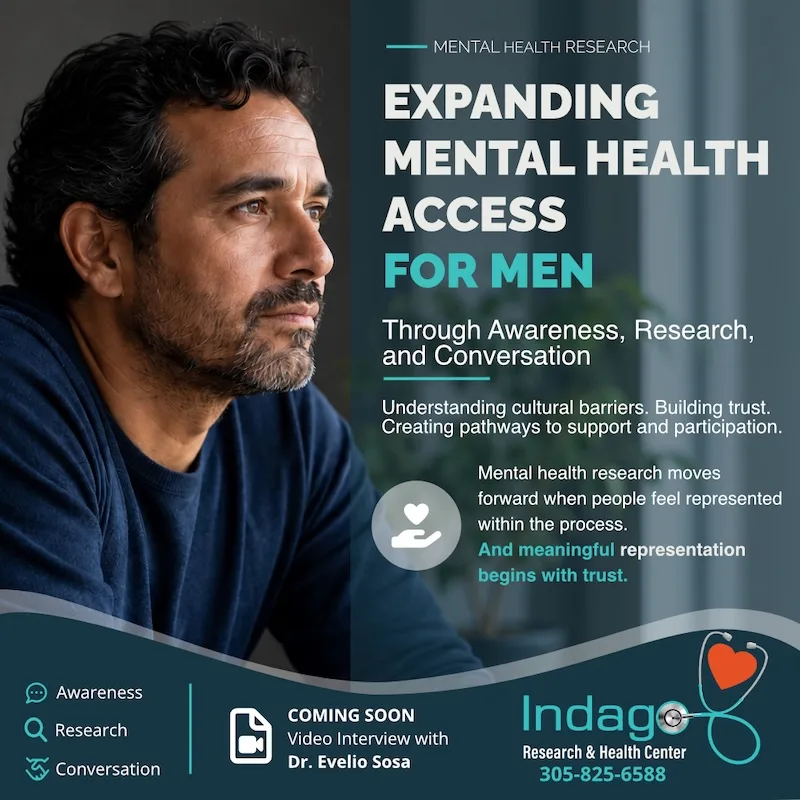
As part of this ongoing conversation, we will soon release a new interview on our website featuring Dr. Evelio Sosa, focused on mental health awareness among men, cultural barriers that may limit engagement, and the importance of building more open pathways toward support, participation, and understanding.
Mental health research moves forward when people feel represented within the process.
And meaningful representation begins with trust.
Making our community healthier. Together.